
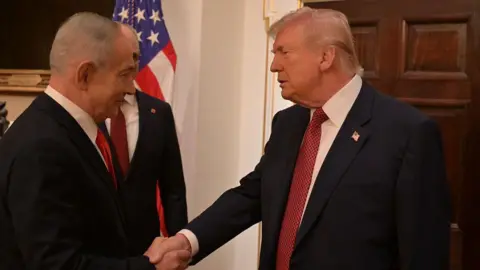
US President Donald Trump said he insisted talks with Iran continue during a meeting with Israeli Prime Minister Benjamin Netanyahu, but warned he may take action against Tehran if a nuclear deal is not reached.
The leaders met at the White House as tensions continue to rise across the Middle East and negotiations intensify over curbing Iran’s nuclear weapons programme.
Netanyahu was expected to press Trump to pursue a deal that would not only halt Iran’s uranium enrichment, but cut its ballistic missile programme and support for proxy groups like Hamas and Hezbollah.
Iran has suggested it is ready to limit its nuclear programme in return for sanctions relief, but has rejected other demands.
Ahead of the White House meeting, Iranian President Masoud Pezeshkian warned his country would “not yield to their excessive demands”.
Netanyahu’s visit marks his sixth trip to the US since Trump’s return to office – more than any other world leader.
The leaders spoke for nearly three hours in an unusually low-key meeting in which Netanyahu was brought in through a side entrance, out of view of the cameras.
Trump did not hold a press conference with him afterwards.
In a post on Truth Social, Trump said the meeting between the leaders had been “very good”.
“There was nothing definitive reached other than I insisted that negotiations with Iran continue to see whether or not a deal can be consummated,” he said.
He added a deal was his “preference” but if one could not be reached “we will just have to see what the outcome will be”.
Netanyahu’s office said the leaders had discussed “the security needs of the State of Israel in the context of the negotiations” and agreed to continue their “close coordination and relationship”.
A close Trump ally, Netanyahu has long argued that Iran represents an existential security threat to Israel and has pushed the US to curb Tehran’s influence in the region.
“The prime minister believes that any negotiations must include limiting ballistic missiles and ending support for the Iranian axis,” Netanyahu’s office said in a statement ahead of his trip.
After arriving in Washington on Tuesday, Netanyahu met Trump’s special envoy Steve Witkoff and son-in-law Jared Kushner. The pair “provided an update on the first round of negotiations they held with Iran last Friday”, according to the prime minister’s office.
Netanyahu’s visit comes as the US increases its military presence in the Middle East, with Trump warning Tehran of strikes if it fails to reach a deal on its nuclear programme and to stop killing protesters.
On Tuesday, the president said that he was “thinking” about sending a second aircraft carrier strike group to the Middle East.
The USS Abraham Lincoln carrier strike group was sent to the region last month after Trump threatened to strike Iran to stop a government crackdown on mass protests in which thousands of people were killed.
“We have an armada that is heading there and another one might be going,” Trump said in an interview with Axios. He said Iran “wants to make a deal very badly”, adding that a diplomatic solution remained possible.
Trump told Fox Business that a good deal would mean “no nuclear weapons, no missiles”.
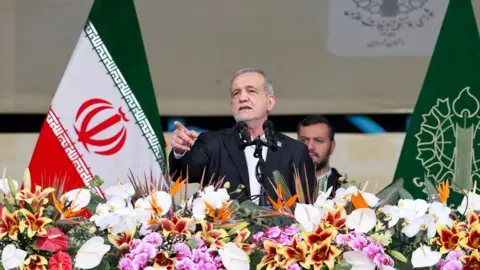 Iranian Presidency/WANA/Handout via REUTERS
In a speech at a rally in Tehran on Wednesday marking the 47th anniversary of Iran’s Islamic revolution, Pezeshkian said: “Our Iran will not yield in the face of aggression, but we are continuing dialogue with all our strength with neighbouring countries in order to establish peace and tranquillity in the region.”
The Iranian president also reiterated that his country was “not seeking to acquire nuclear weapons”. “We have stated this repeatedly and are ready for any verification,” he added.
Israeli officials have also said their country reserves the right to take military action against Iran if it does not reach a nuclear agreement with the US.
Netanyahu is under pressure from far-right allies in his government to use his ties to Trump to push for a wide-ranging US-Iran deal that meets the Israeli government’s security concerns, experts say.
“Israel is concerned that in the haste to get a deal with Iran, the president might embrace a deal that doesn’t address Iran’s missile programme or support for proxy groups, or that allows it to have some remnant of its nuclear programme,” said Daniel Byman, a professor at Georgetown University’s School of Foreign Service.
“One worry Israel and other allies have about the US under Trump is that he wants a deal more than he wants a particular outcome,” added Byman.
Analysts say Iran’s leaders are in a weaker position now after the mass protests and a 12-day air campaign by the US and Israel last year, during which Iranian nuclear and military sites were bombed.
“The Iranian regime today is really vulnerable,” said Mohammed Hafez, a professor at the Naval Postgraduate School and expert on Middle Eastern politics. “The US and Israel feel they hold all the cards, Iran is on its back foot, and they can make these maximalist demands.”
Trump withdrew the US from an Obama-era nuclear deal with Iran in his first term in office and reinstated sanctions that have severely strained its economy. The administration restarted talks last year to reach a new deal before the war between Israel and Iran.
Despite this heightened rhetoric in recent weeks, Trump might still wish to avoid a direct military conflict with Iran if the nations cannot strike a nuclear deal, former US officials said.
“I don’t think Trump wants a major military confrontation with Iran going into an election year,” said James Jeffrey, a former US ambassador to Iraq and Turkey. “And I think the Iranians know that.”
The visit also comes as the Trump administration presses Israel and Hamas to implement the next phase of their ceasefire agreement in Gaza.
On Wednesday, Netanyahu met US Secretary of State Marco Rubio to sign up as a member of Trump’s Board of Peace.
A White House spokesperson said Israel “has had no better friend in its history than President Trump”.
“We continue to work closely with our ally Israel to implement President Trump’s historic Gaza peace agreement and to strengthen regional security in the Middle East,” said Anna Kelly, the spokesperson.
Israel and Hamas agreed to a ceasefire last October, ending a two-year war started by the 7 October 2023 Hamas attack inside Israel. Approximately 1,200 people were killed and 251 were taken hostage in the attack. Israel’s military campaign in response has killed more than 71,000 people, according to Gaza’s Hamas-run health ministry.
Israel and Hamas have accused each other of frequent violations of the ceasefire since the first phase of the deal went into effect.
The sides have not made much progress in moving to the second phase in the ceasefire deal, which calls for the disarmament of Hamas, a full withdrawal of Israeli military forces from Gaza, and reconstruction of the coastal territory.